SEE? It's possible to "spin" any facts in order to make Republican talking points... Then you can repeat them endlessly on Fox News... And all the other Talking Heads that promote MAGA MORONISM...
Let's Teach ACCURATE HISTORY in School. The GOP is Fighting to Outlaw Truth... Fight Back! Post Accurate History Online... Write Your Own Blog and Publish FACTS!
That Would be a Great School Project... Simply DO the Research... Write and PUBLISH... Email Your Report to Everyone You Know and ask Them to Forward it... and... Post a Introductory Paragraph and a LINK to Your Blog on a Dozen Social Networks... It's Easy to FIGHT BACK against the GOP That is Trying to WHITE WASH American History with Tales of Happy Slaves... "Free Boat Ride To America? Guaranteed Job for Life? Who Could Resist Such an Offer?" UH... EVERYONE... Slavers Had to Use Chains to Convince People to Get On Board...
There Was Fifteen Years of Peace Following the End of The Vietnam War. WE WOKE UP! Americans Refused to Participate in Bogus Wars for Corporate Profit.Who Won the War?
DOW CHEMICAL Selling Napalm and Agent Orange...
BELL HELICOPTER Sold 7,700 Hueys
Here's a List of Social Networks: Facebook, Parler, GAB, Ello, Mastodon, Minds, Twitter, Deviant Art, LinkedIn, MeWe, Tumblr, Flipboard, Instagram, Threads, Bluesky and Occupy... Remember to add a Picture to Your Posts... People Click on Pictures! Reddit!
~~~~~~ (~);-} ~~~~~~
Heather Cox Richardson Posted:
July 7, 2021 (Wednesday)
Last week, the Bullock Texas State History Museum cancelled a book event three and a half hours before it was supposed to start. Written by journalists Bryan Burrough, Chris Tomlinson, and Jason Stanford, the book is titled “Forget the Alamo,” and, according to historian H. W. Brands, who reviewed the book for the Washington Post, it both introduces the story of the Alamo to readers unfamiliar with it and explains how the story has been interpreted since the 1836 battle occurred, using the ways in which British musicians Phil Collins and Ozzy Osbourne interacted with the site as a new lens.
Historians long ago put aside the heroic story of the Alamo, which told of freedom-loving Americans fighting off a Mexican tyrant who was trying to crush a fledgling republic. In the past several decades, so many historians have rewritten this history that Brands notes that the new retelling “sometimes appear[s] to be beating a horse that, if not dead, was put to pasture awhile back.”
Historians have explained how Mexican officials, eager to stabilize their northern borderlands after their own agreements with Apache tribes fell apart, permitted Americans to settle in what is now Texas. Americans moved to the area to grow cotton in the boom years of that era. When Mexico banned slavery in Texas in 1830, Americans rebelled. In October 1835, they joined with Mexican opponents of President Antonio López de Santa Anna’s government and went to war. By December, the Texian Army had pushed Mexican troops out of the Mexican territory of Texas, and the Texians hunkered down in the Alamo Mission near what is now San Antonio. In January, reinforcements, including James Bowie and Davy Crockett, arrived. About 200 Texians were there on February 23, 1836, when 1800 of Santa Anna’s troops laid siege to the Alamo. On March 6, Santa Anna’s troops attacked, killing almost all of the defenders (but not Davy Crockett, who surrendered and was executed later).
This history is well established… but Lieutenant Governor Dan Patrick—who in March 2020 suggested that elders should be willing to die from Covid-19 in order to get the economy moving again—was one of apparently a number of Republican leaders who demanded that museum officials cancel the event. Governor Greg Abbott, Patrick and other Republican leaders are board members of the State Preservation Board, which oversees the Bullock Museum. “As a member of the Preservation Board, I told staff to cancel this event as soon as I found out about it,” Patrick tweeted. “[T]his fact-free rewriting of TX history has no place [at the Bullock Museum].”
As of the end of June, nine states have passed so-called “divisive concepts” laws, and 17 more are considering them. These measures try to control how teachers talk about issues of race, sex, ethnicity, religion, color, or national origin, saying that such discussions are divisive. Yet, as historians James Grossman and Jeremy Young of the American Historical Association noted yesterday in The Hill, a survey by the American Historical Association and Fairleigh Dickinson University shows that, “regardless of political identity, age, race, gender or education level,” there is broad consensus that these issues provide essential content to understand our history and that they are appropriate for school history classes.
“We should be clear about what’s happening here,” Young and Grossman say. “This is the legislative equivalent of push-polling—creating division where none exists, raising fears about something that isn’t even happening to score political points.”
They point out that the bills are not coming from people in school districts, but instead follow a template produced by an organization led by Russell Vought, the former director of the Office of Management and Budget under the Trump administration. The organization’s website has a file on it titled: “Model-School-Board-Language-to-Ban-CRT-SD-HCS-edits-1.”
Here’s why this rewriting of our history matters.
Historians study how societies change. In order to do that, we examine sources created at the time—newspapers, teapots, speeches, tweets, photographs, landscapes, and so on-—and judge what we think happened by comparing these primary sources to things other historians have said, on the basis of evidence they have found. We argue a lot. But if we cannot see an ever-widening story, we cannot give an accurate account of how societies change.
An inaccurate picture of what creates change means that people cannot make good decisions about the future. They are at the mercy of those who are creating the stories. Knowledge is indeed power.
So the destruction of accurate history is about more than schools. It’s about self-determination. It’s about having the freedom to make good decisions about your life.
It’s about the very things that democracy is supposed to stand for.
HISTORY:
'Forget The Alamo' Author Says We Have The Texas Origin Story All Wrong... Read More:
https://www.npr.org/2021/06/16/1006907140/forget-the-alamo-texas-history-bryan-burrough
Interview Highlights
On how Texas history often fails to address slavery...
It still surprises me that slavery went unexamined for so long. But then you have to understand: The Texas revolt, for 150 years, was largely ignored by academics, in part because it was considered déclassé, it was considered provincial, and because the state government of Texas, much as they're doing now, has for 120, 130 years, made very clear to the University of Texas faculty and to the faculty of other state-funded universities that it only wants one type of Texas history taught ... and that if you get outside those boundaries, you're going to hear about it from the Legislature.
https://en.wikipedia.org/wiki/History_of_slavery_in_Texas
The history of slavery in Texas began slowly at first during the first few phases in Texas' history. Texas was a colonial territory, then part of Mexico, later Republic in 1836, and U.S. state in 1845. The use of slavery expanded in the mid-nineteenth century as White American settlers, primarily from the Southeastern United States, crossed the Sabine River and brought human beings they had enslaved with them. Slavery was present in Spanish America and Mexico prior to the arrival of American settlers, but it was not highly developed, and the Spanish did not rely on it for labor during their years in Spanish Texas.
The issue of slavery became a source of contention between the Anglo-American settlers and Spanish governors. The governors feared the growth in the Anglo-American population in Texas, and for various reasons, by the early 19th century, they and their superiors in Mexico City disapproved of expanding slavery. In 1829 the Guerrero decree conditionally abolished slavery throughout Mexican territories. It was a decision that increased tensions with slave-holders among the Anglo-Americans.
After the Texas Revolution ended in 1836, the Constitution of the Republic of Texas made slavery legal. Sam Huston made illegal importation from Mexico a crime in 1836. The General Provisions of the Constitution forbade any slave owner from freeing his slaves without the consent of Congress and forbade Congress from making any law that restricted the slave trade or emancipated slaves.
Americans of European extraction and slaves contributed greatly to the population growth in the Republic and State of Texas. Settlements grew and developed more land under cultivation in cotton and other commodities. The cotton industry flourished in East Texas, where enslaved labor became most widely used. The central part of the state was dominated by subsistence farmers. Free and runaway blacks had great difficulty finding jobs in Texas. Many worked in other parts of the state as cowboys herding cattle or migrated for better opportunities in the Midwest, California, or southward to Mexico.
~~~~~~ (~);-} ~~~~~~
1619 Project: #MoscowMitch McConnell is Reviving Interest in The 1619 Project Again... Now, It's a GOP CANCEL CULTURE CAUSE! He Wants the US Government to BAN Teaching the History of Slavery in the USA... In Public Schools...
https://en.wikipedia.org/wiki/The_1619_Project
The 1619 Project is a long-form journalism project developed by Nikole Hannah-Jones, writers from The New York Times, and The New York Times Magazine which "aims to reframe the country's history by placing the consequences of slavery and the contributions of Black Americans at the very center of the United States' national narrative."
FULL ISSUE OF THE NY TIMES ARTICLE:
https://pulitzercenter.org/sites/default/files/full_issue_of_the_1619_project.pdf
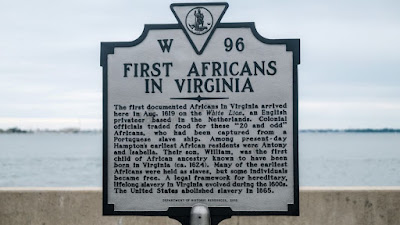 |
Historical Marker: 1619 First Africans in America
Remember: the Pilgrims Arrived in 1620
at Plymouth Rock... Widely Taught in History Class |
Nikole Hannah-Jones Responds To Republican Efforts To Censor 1619 Project:
The Pulitzer-winning journalist said efforts to censor the project, which examines American racism since 1619, are about “trying to prohibit the teaching of ideas they don’t like.”
A Brief History of the Vietnam War. 58,000 Americans Died for Nothing... Something They Don't Teach in School Now... "Too Controversial" - During the 1950s Americans went into a Mad Panic about Communists taking over the world.
We built thousands of Nuclear Missiles and fallout shelters. The US Congress had witch hunts (Joe McCarthy-HUAC) to expose "Commies" who worked in The Hollywood Movie business and blacklisted folksingers that were leading our young people astray with Labor Union Organizing songs. During the height of this hysteria Vice President Richard Nixon went on Television and explained "the Domino Principle" while pointing to a map of Asia. His theory was that one by one those countries over there would turn Commie and soon they would take over Mexico and threaten the American Way of Life. President Eisenhower and Kennedy sent advisors to help the South Vietnamese soldiers fight the North Vietnamese soldiers. Then President Johnson sent even More American Soldiers to fight the Viet Cong. Then President Nixon continued the War for another 5 years before eventually he decided to allow the South Vietnamese to fight their own war and we left. Quickly the South lost and thousands of Boat People fled South Vietnam because they thought they would be killed. As it turned out, The Domino Principle was false. Communism did not take over the world. The entire war was a waste of lives and money.
The main reason we ended the Vietnam War was the huge protest movement against the war. Lead by Abbie Hoffman and Jerry Rubin of the Yippies, The Students for a Democratic Society and The Weatherman staged immense protest marches expressing the desire of the American People to end the war. Eventually the US government got the message...
Ho Chi Minh was the heroic leader of North Vietnam. He successfully threw out the French Colonialists and The Americans. He reunited his country and Vietnamese people ruled Vietnam.
The Vietnam War inspired many anti-war protest songs. Country Joe and the Fish's "Fixing to Die Rag", Arlo Guthrie's "Alice's Restaurant, The Door's "Unknown Soldier and "Where Have all the Flowers Gone" and "Big Muddy" by Pete Seeger...
Then the Draft (forcing people to go fight in wars) ended and we were at Peace for Ten Years...
Many corporations profited from the War in Vietnam including Dow Chemical, Monsanto and Hughes Aircraft. The Government bought a lot of Napalm, Agent Orange and Helicopters.
Some say that corporations had President Kennedy Assassinated because he was going to end the war and they wouldn't reap the profits...
President Lyndon Johnson was the main promoter of the Vietnam War. He is the one that changed from sending advisors to sending combat troops. Even after it became obvious that we could not win he continued to send more combat troops because he did not want to be the first President to lose a war. Robert McNamara was the Secretary of Defense at the beginning of the war and then he quit because all his experts said that we could not win. At one point, Barry Goldwater (The Republican Candidate for President) recommended dropping Atomic Bombs on Hanoi but he lost the Election to LBJ and we never dropped any. We did drop an astonishing amount of traditional bombs, Napalm
(jellied gasoline) and Agent Orange (a defoliant). That killed about two million Vietnamese people. Since they were fighting in defense of their own country they were able to outlast the Americans because they were interested in winning. The American public became opposed to the war in such numbers that eventually Richard Nixon ended the war. At one point, Nixon was so afraid of the protesters that he encircled the White House with Buses parked end to end so that people could not jump over the fence and attack. One protest march walked from the Lincoln Memorial in DC to the Pentagon in Virginia and encircled it. The plan was to hold hands, sing and chant until the Pentagon levitated into the air vibrated and collapsed into a pile of rubble. This march was documented in the Norman Mailer book "Armies of the Night".
Many thanks to all who protested the war as we saved countless lives. Including my own.


.jpg "Anti-trump meme - he's a danger to the USA")
.jpeg "Anti-trump meme - he's a danger to the USA")
.jpg "Anti-trump meme - he's a danger to the USA")


Popular Posts:

Trump is an Embarrassment to the Republican Party... Going on and on about Arnold Palmer's large penis? Closing a McDonald's so he could do a photo op of him making french fries?
They closed a McDonald's so Trump can stage a photo op. Trump is insane and he's getting worse by the day... How could anyone thin...
.jpg)
Trump Calls Off Civil War - The Insurrection failed last time and it's very likely to fail this time as well. There's no benefit to having 10,000 True Believers go to prison.
Trump's plan is to move to Venezuela where he cannot be extradited for crimes committed... and live a quiet life... Bored with politics,...

No Real Need for Republicans to Vote. Trump's Plan is to Break the Election and Crown Himself King. Take the day off... Relax... Do something fun! Trump will rule the World As a God until he dies and then Ivanka will become Queen...
Meanwhile, In Reality: Trump Lives at MAR-A-LOSER, Florida. President Biden Lives at the White House in Washington, DC... WHY? Because Joe...

Trump Signed the Help Crazy People Buy Guns Law... HJ RES 40... If a person gets a Social Security Disability Check due to INSANITY, They No Longer have to Report That Fact on a Gun Purchase Background Check...
https://www.congress.gov/bill/115th-congress/house-joint-resolution/40 and now we have Madmen Committing Murder again and again and again...

Trump was a Disaster as President. We are Much Better Off Now Than We Were 4 Years Ago. We can Buy Groceries at the Store! We don't have to wait in the long lines at the free food giveaway pantries.
Remember the massive unemployment? Remember the stock market crash? Remember the 1 million Americans that died from Trump's Coronavirus?...

TRUMP IS OLD - Kamala is Very Popular With Generations X, Y, Z and Alpha. If Elected, She Could Expand the Corrupt Supreme Court to 13 People by Appointing 4 SANE JUDGES! Now It's Packed With MAGA MORONS!
THIS IS YOUR CHOICE! The Time Has Come to Pass the Torch to a New Generation! Christmas ornaments for sale SE SAID: All the recent focus ...
%20(1)%20(4)%20(1).jpg)
Where do we go from here? So much effort has been put into beating Trump like a pinata... But soon that will all be over... And then what?
I believe the most important subject is climate change... Here in California, we had another summer of wildfires and people I know had their...

Ancient UFO Drawings, Paintings - before the invention of cameras, This Is How They documented flying saucers and extraterrestrials...
UFOs in Ancient Art. Fresco detail Crucifixion of Jesus. Decani Monastery Serbia. UFO shining a beam in a Renaissance painting A giant...

Psychedelic Art Playing Cards for sale. A practical and fun gift that will last for a hundred years... Pass 'em down to your grandchildren... And great-grandchildren...
click here for the newest playing card designs more playing cards for sale at Zazzle Gregvan I gave a deck of playing cards to my brother fo...

-ai prevents the artificial intelligence overview from being displayed when using Google Search. MINUS SIGN AI included anywhere in your question... For example:
What is the meaning of the song Quinn the Eskimo -ai displays links to web pages discussing the meaning of the song... And a sentence descri...

%20(1)%20(1)%20(1).jpg "Dancing elephant in a disaster area cartoon")
.jpg)


%20(1)%20(1)%20(1).jpg "PROPAGANDA: American Happiness Peaked in the 1950s BEFORE Television Brainwashing Convinced Us That We Were Unhappy Unless We Bought Their Plastic Crap.")
.jpg "Psychedelic Art by gvan42")


.jpg)


.jpg)
.jpg.jpg)

.jpg)


.jpg "Chart of US Military Deaths by War")


.jpg "Anti-trump meme - he's a danger to the USA")
.jpeg "Anti-trump meme - he's a danger to the USA")
.jpg "Anti-trump meme - he's a danger to the USA")


.jpg)


%20(1).jpg)

%20(4)%20(4).jpg)


.jpg)
.jpg)
